
History has a funny way of sneaking lessons past you in plain sight, rarely in the form of a flag, often in the rise of a corporation, and sometimes in the very structure of global power itself. Take the British East India Company, for example. Chartered in 1600 to manage trade for the Crown, it eventually became something that looked more like a state than a company: with armies, territories, and the power to govern millions. Fast forward a century or two, and the Virginia Company establishes colonies in North America, semi-autonomous settlements with local governance, economic systems, and a population growing accustomed to running itself.
When those colonies broke from Britain, they didn’t just create a nation, they evolved a system from the corporate frameworks that originally subordinated them. In many ways, the United States is an unintentional heir to these early corporate-colonial experiments: a society built on self-sufficiency and institutional know-how derived from chartered entities, yet capable of severing the ties that gave those companies power in the first place.
And then there’s the flag. The early American Grand Union Flag and the later current U.S. flag, with their alternating red and white stripes, echo the East India Company banner, which similarly used red-and-white stripes beneath the Union Jack. Scholars debate whether the resemblance is coincidence, homage, or subconscious influence, but it’s hard to ignore the symbolic continuity. Stripes that once represented colonial control now symbolize a nation breaking free, yet the echo of corporate-imperial power remains in plain view.
To put the evolution of power into modern context, consider this side-by-side comparison:
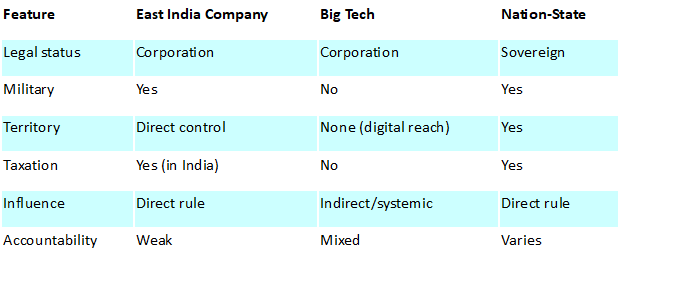
Look closely, and you’ll see a pattern: entities that amass enough resources and control, whether corporate, technological, or governmental, begin reshaping the rules of the systems around them, often to the benefit of the top echelons and the detriment of the broader population. The East India Company directly ruled territories, Big Tech indirectly governs the flow of information and commerce, and nation-states combine both hard and soft power. Across centuries, the mechanics may change, but the trajectory is eerily similar.
For the global working populations, the lesson is stark: history shows that when power concentrates, whether in chartered corporations, sprawling tech conglomerates, or centralized governments, the rules begin to serve the few, not the many. It is not enough to simply participate within existing systems; we must actively design and impose frameworks that distribute power equitably and prevent concentrations that allow elite corporate actors to rewrite the rules of history in their favor. Stripes in a flag, armies, or digital platforms are all expressions of the same underlying phenomenon: power left unchecked ultimately protects itself. Humanity’s challenge now is to imagine structures where that pattern no longer dominates, act before history repeats… yet again and revolutionize global labor.